
Since Vox Stella 3.0 arrived in May 2026, the desktop app has gone through more than sixty updates. Most were careful corrections: timing that now matches published references, dignities scored the way Lilly scores them, and elections weighed by the rules in the traditional texts.
Three changes stand above the rest. Factor research turns Vox Stella into astrology research software: you can test which chart factors your own charts show more often than chance would explain. Forensic has been rebuilt from end to end, and it now reads each event chart with 24 case-pattern models. And the whole app has a calmer, easier-to-read look.
This post walks through Factor research step by step, then covers the rebuilt Forensic engine and the fixes you will notice in daily work.
Factor research: astrology research software inside Vox Stella
Astrologers have always collected charts and looked for what they share: the Moon in a certain phase at weddings that lasted, Mars on an angle at accidents, the ruler of the 7th in a given house when two people knew each other. The hard part has always been the same question: is the pattern real, or would random charts show it just as often?
Factor research is built to answer it. You give it a group of charts. It casts every chart, counts more than fifty families of factors in each one, compares the counts with comparison charts, and tells you which factors stand out and how many would stand out by chance alone. It can then train four kinds of pattern model on what it found and check them on charts they never saw.
You do not need to know statistics. Every result is written as a sentence, and the app warns you when a study is too small or when a score could be luck.
A worked example: forty solar eclipses
The best way to learn a research tool is to give it a question you already know the answer to. A solar eclipse can only happen when the Moon passes in front of the Sun, so eclipse charts must show the Sun and Moon together far more often than ordinary dates do.
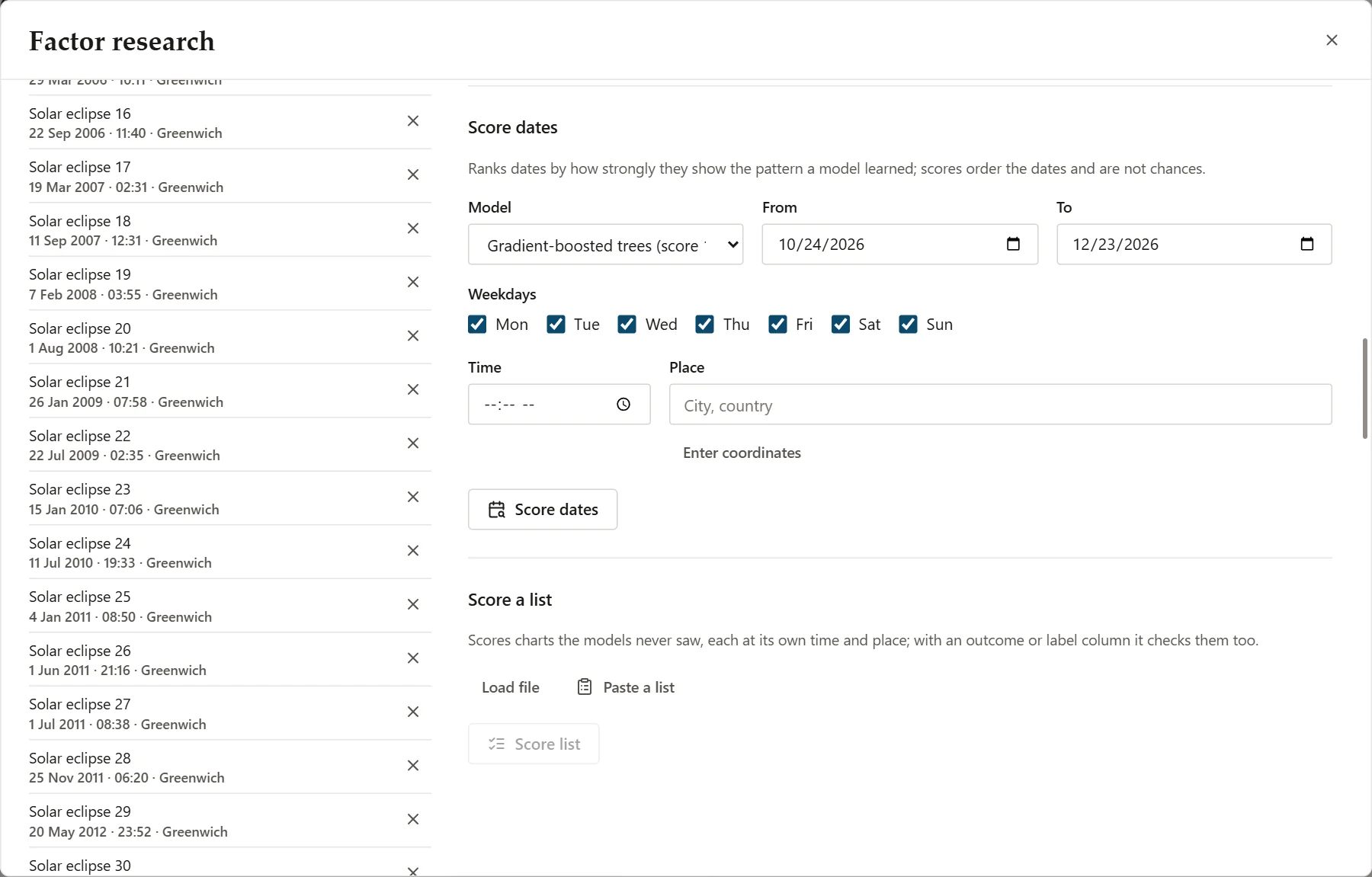
We loaded the moments of 40 solar eclipses between 2000 and 2017, cast for Greenwich, chose the Reference set of factor families, Regiomontanus houses and traditional rulers, and ran a Frequency test against random dates.
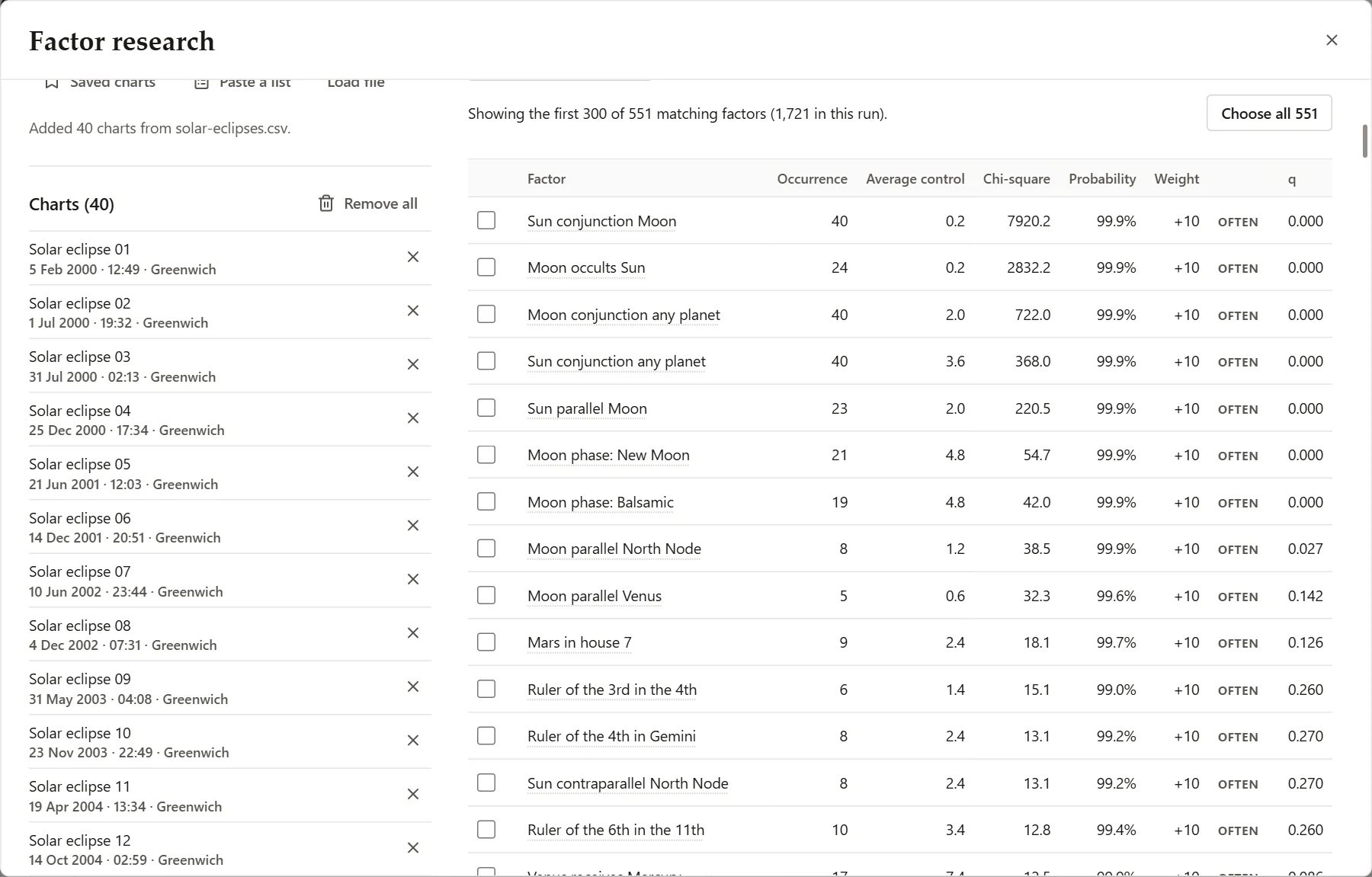
The answer took nine seconds. Sun conjunction Moon appeared in all 40 eclipse charts and in 0.2 of the average set of control charts. The Moon occulted the Sun in 24, against 0.2. The New Moon phase showed in 21, against 4.8. Those are exactly the signatures an eclipse should leave.
Just as useful is what the app said about everything else. Of 551 measured factors, 31 reached 95%, and the summary line says that chance alone would carry about 31 that far. When hundreds of factors are tested, a single one at 95% means little on its own.
So the app adds a second, stricter measure, q, which compares each chart with its own controls and allows for how many factors were tested. Only 8 factors reached q 0.05 or less. Every one of them was a Sun, Moon or lunar node signature, and all 8 held on a second, fresh draw of control charts.
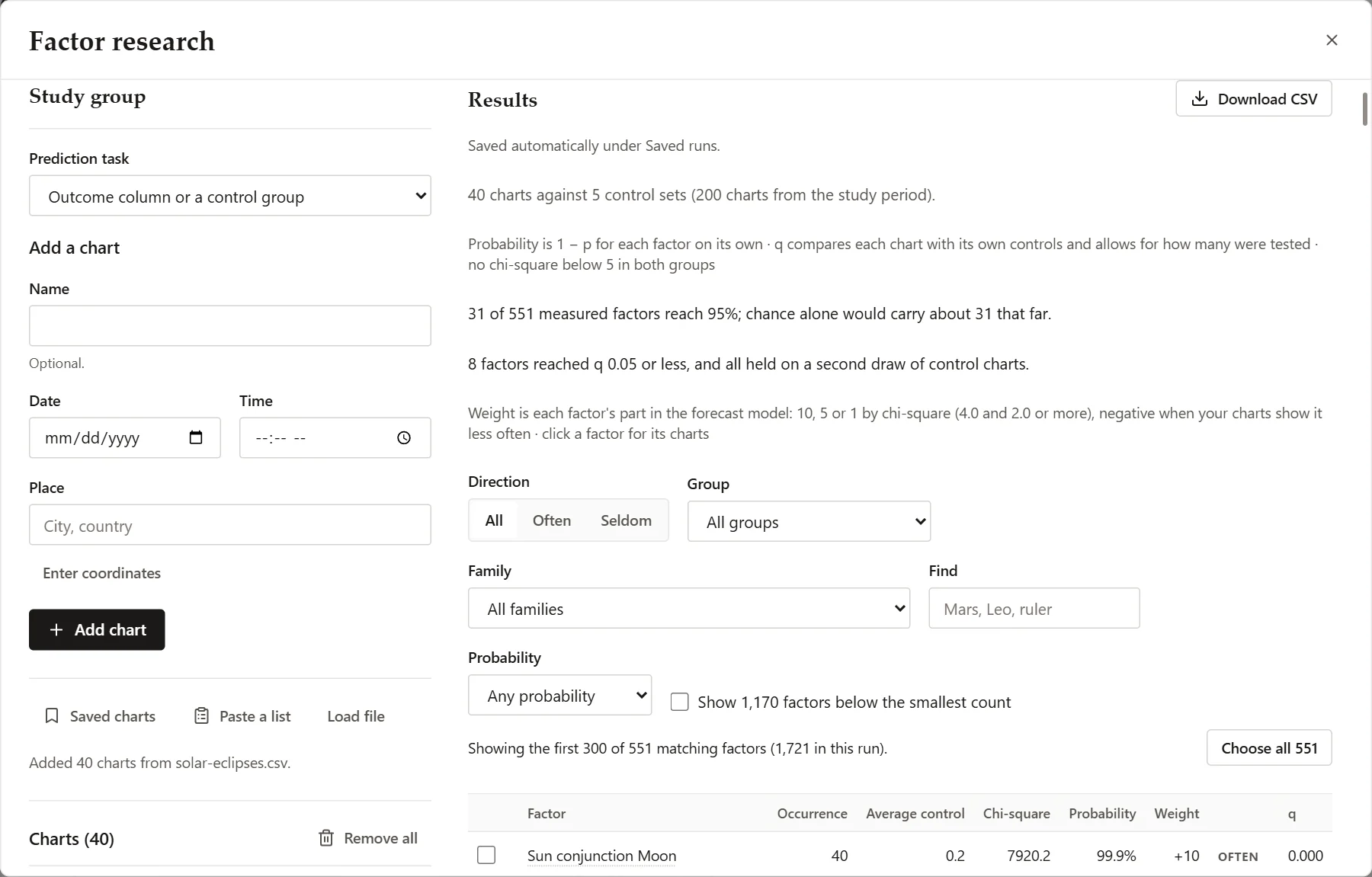
How to run your own study
- Build your study group. Type a date, time and city, tick saved charts, paste a list, or load a CSV or text file. Each row keeps its own time zone and place.
- Choose what to compare with. Random dates recasts every chart at the same place and clock time on other dates from your study period, optionally on the same weekday or near the same time of year. My own list compares your charts with a second group you load, for example weddings that lasted against weddings that ended.
- Pick the factors. Start from a preset or choose families: signs and houses, aspects and parallels, Moon phases, dignities and receptions, house rulers and the links between them, lots, fixed stars, lunar mansions, midpoints and more. Choose the house system and traditional or modern rulers, and leave out the slow planets if you prefer.
- Run the Frequency test. Read the summary first, then the table. Click any factor to see the charts behind it, and combine factors with and, or and not.
- Train Pattern models. Let the models pick their own top factors, or send them the factors you ticked.
- Score new charts. Use Score a list to test the trained models on cases they never saw, or Score dates to rank upcoming dates by the pattern a model learned.
Pattern models: four ways to learn a pattern
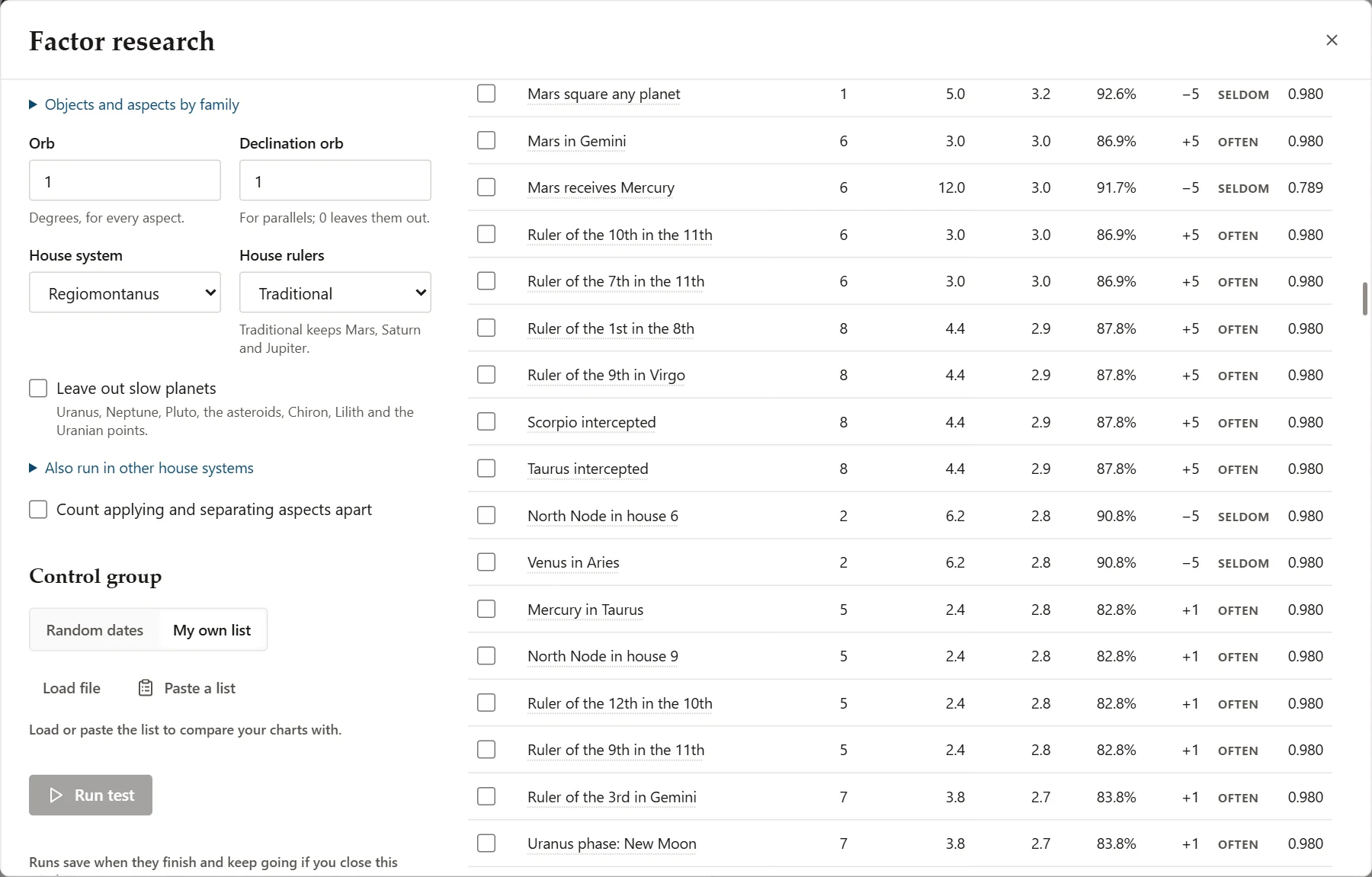
A Frequency test looks at one factor at a time. Pattern models look at many together. Vox Stella trains four of them side by side: gradient-boosted trees, a neural network, logistic regression and a classic network. Each learns from your earlier charts and is then scored on your latest ones, which it never saw while training.
On the eclipse study, all four models told eclipse dates from random dates on the later charts with a score of 1.00. To show that this was not luck, the app also retrains every model on shuffled labels: those runs scored about 0.46, close to the 0.50 of pure chance. Each model lists the factors it relies on, and all four list Sun conjunction Moon among them.
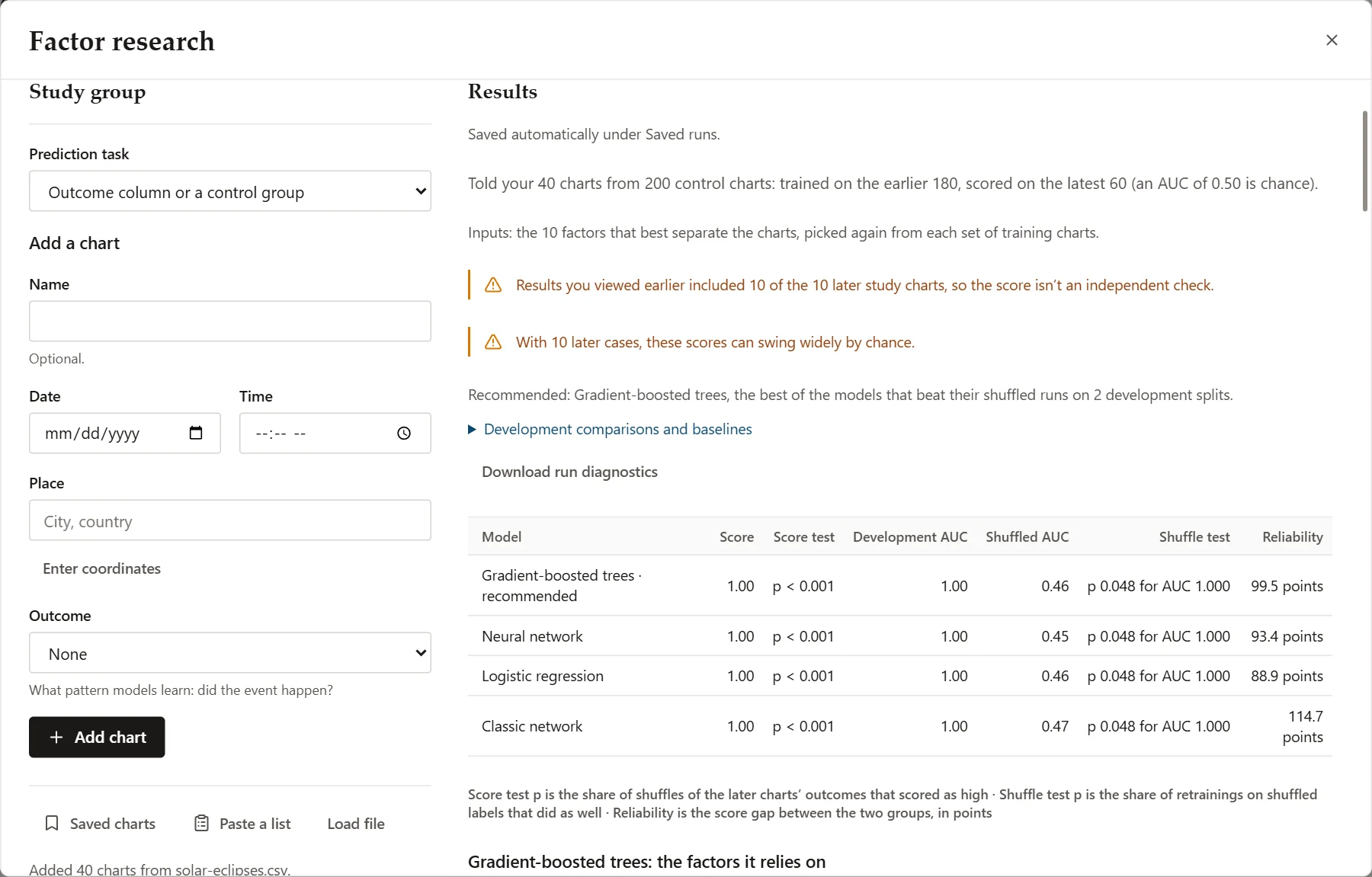
Notice the two warnings above the table. The app reminds you that the later charts were already visible in the Frequency test, and that ten later cases can swing a score by chance. It shows these warnings even when the answer is perfect, because a research tool should be just as strict with good news.
Once a model has learned a pattern, two tools put it to work. Score a list tests the trained models on cases they never saw and checks whether chance could explain the result. Score dates ranks a range of upcoming dates by how strongly they show the pattern a model learned.
Built to keep you honest
The difference between astrology statistics that mean something and statistics that only look impressive is how they handle chance. Factor research builds that discipline in:
- A chance line on every test: how many factors random charts would flag, so noise never looks like a finding.
- A second draw of control charts for the strongest results, with any that do not hold marked.
- Both halves: see which factors hold in the earlier and the later half of your charts.
- Models scored on later charts and compared with shuffled runs, with a luck check on every score.
- Plain warnings when your events cluster in certain years or months, or when a study is too small for models.
What you can study with Factor research
- Weddings that lasted against weddings that ended.
- Business launches that grew against launches that closed within two years.
- Horary questions that came true against those that did not.
- Two kinds of documented event, such as accidents at sea and accidents on land.
- Your own client records, labelled the way you work.
The more charts with reliable times you collect, the more a study can tell you. A few dozen charts can show a strong signature like the eclipse one; subtler patterns need many more, and the app tells you when yours is too small.
A rebuilt forensic astrology engine
Forensic is Vox Stella's workspace for studying event charts of documented incidents. Over the 3.x releases it was rebuilt from end to end so that every reading can be traced to a rule from the source books.
- Rules from the books. Readings now follow the traditional sources more closely, and the Descendant sign describes the other person.
- Fewer false labels. Home, travel, water and social symbolism stays background until other evidence backs a specific reading, so a chart is no longer called a drowning or an abduction on one placement alone.
- A fairer survival reading. Each danger counts once, and an accident no longer implies a fatal outcome by itself.
- Relationships from relationship rules. The relationship reading uses only rules about relationships, and lists each reason once.
- Clearer tabs. Victim, Counterpart, Relationship, Witnesses and the other tabs now list only what the chart shows, as short, plain rows.
Case patterns: 24 models trained on past cases
The biggest addition is the Patterns tab. Using Factor research, we trained 24 models on pairs of past case groups: partner against stranger, work or school against stranger, abduction against open attack, road crash against aviation accident, and more. Each model looks at a new event chart and says which of its two kinds of case the chart is closer to, and how strongly. Open a row to see what each of its four models says on its own.
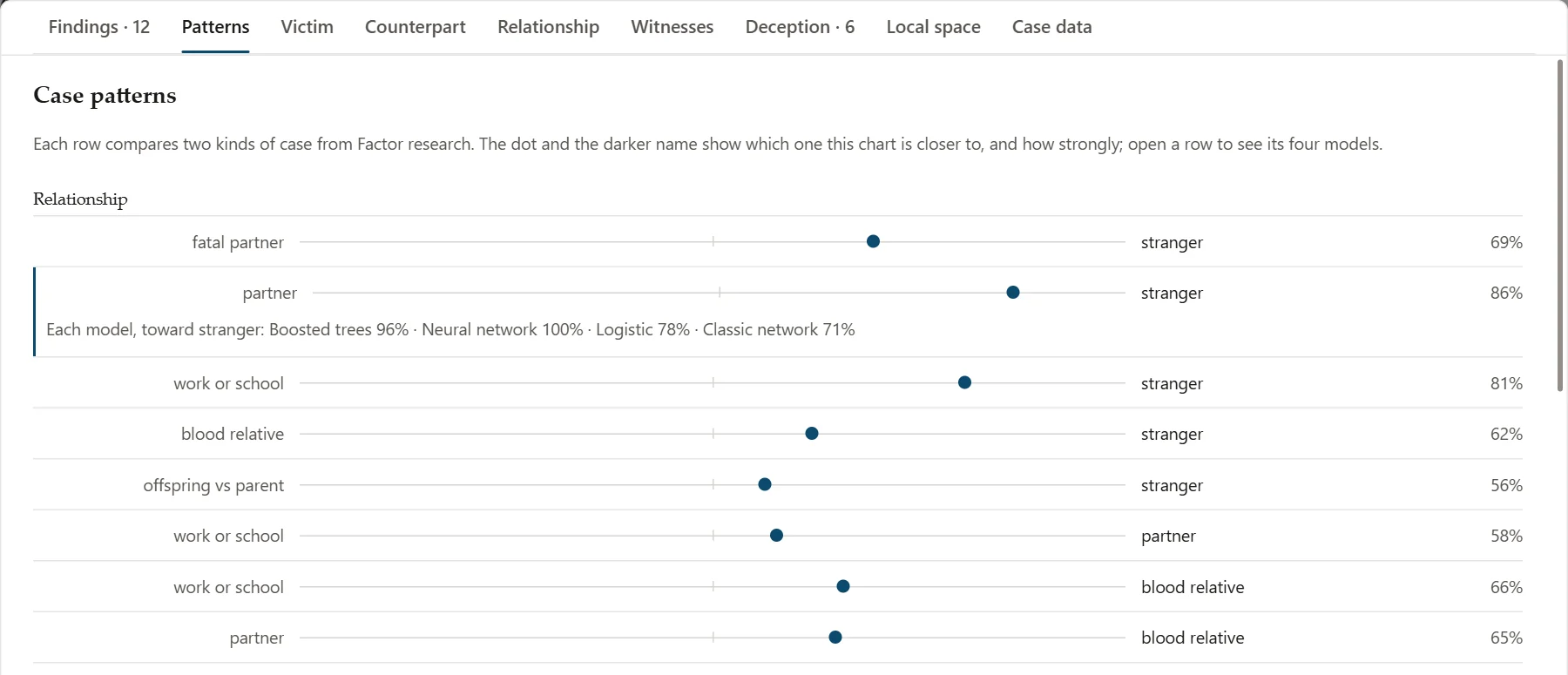
The case patterns also feed the violence, abduction and accident readings on the Findings tab, and each of those readings says whether it came from the rules, from the case patterns, or from both. Forensic remains a research and teaching tool for astrologers: it cannot identify anyone and should never be used to accuse a person or to direct a real investigation. Read What Is Forensic Astrology? for the method and its limits, or see the Forensic dashboard guide.
Accuracy fixes you will notice
Not every improvement makes a headline, but these change what you see on screen:
- Planetary hours, fixed stars and Chinese hour pillars now match published references, including early-morning and far-north locations.
- Transit timing: exact transit times and solar and lunar returns follow the correct dates and time zones, and repeated scans no longer inflate a transit's strength.
- Planet strength by Lilly's table: peregrine planets, mutual reception, house placement and speed are scored as Lilly gives them.
- Aspects show exact times, applying and separating correctly, and a choice of Lilly, Morin or modern orbs.
- Elections follow Bonatti and Morin: each election type weighs the rules from the texts, an Ascendant ruler in the 6th, 8th or 12th lowers a time, and help from retrograde, combust or fallen planets is weakened.
- Horary times are preserved: a question cast at a custom time keeps that exact moment in the saved chart.
- Chinese astrology is careful with unknown birth times and seasonal boundaries.
New tools and a calmer look
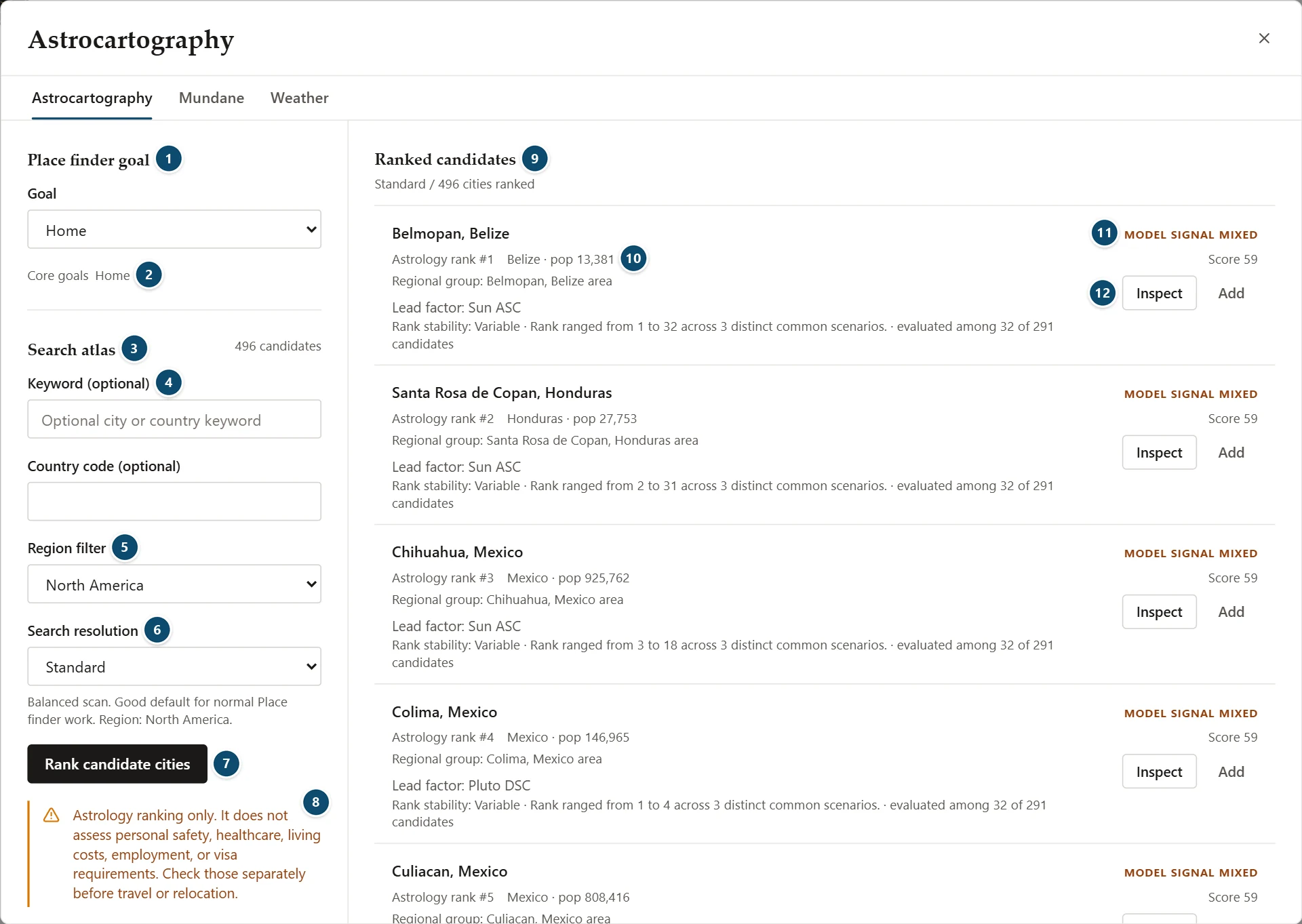
- Place finder in Astrocartography: shade the world map where your chart scores best for education, love, work or money, and see the placements behind each city's score. Midheaven lines now mark where each planet is overhead, and transit lines show where the planets touch your own angles.
- Birth-time check: test dated life events against possible birth times in one focused workflow.
- Transits, progressions and profections around any saved birth chart, with exact aspects listed.
- A paper-and-ink look: every screen reads like a printed almanac, with larger text and dark mode everywhere.
How to update
- In the app: open Vox Stella, go to Settings and check for updates.
- Or download again: get the latest Windows installer from the product page and run it. Your license, saved charts and preferences stay in place.
New to Vox Stella? Explore every workspace, from horary and electional astrology to synastry and forensic astrology, on the features page.
FAQ
What is astrology research software?
It is software that lets you test astrological ideas on real charts. In Vox Stella, Factor research casts a group of charts, counts their factors, compares them with comparison charts and tells you which factors appear more often than chance would explain.
Do I need to know statistics to use Factor research?
No. Results are written as plain sentences, and the app tells you when a study is too small, when events cluster in certain years, or when a model's score could be luck.
Can Factor research prove that astrology works?
It answers a narrower and more useful question: do the factors you are interested in appear in your charts more often than in comparison charts, by more than chance would give? What you learn depends on how many charts you collect and how reliable their times are.
How many charts does a study need?
A strong signature, like the Sun and Moon together at eclipses, shows clearly in a few dozen charts. Subtler patterns need many more, and Pattern models warn you when the study is too small to score fairly.
What are the 24 case patterns in Forensic?
They are models trained with Factor research on pairs of past case groups, such as partner against stranger cases. Each one says which of its two kinds of case a new event chart is closer to, and how strongly.
Does Vox Stella run on Windows only?
Yes. Vox Stella is a Windows desktop app. Download it from the product page.