
Election astrology can sharpen launch timing. This guide shows how to apply it to a business launch: the factors that matter most, a 10-point checklist, a full analysis of the Flappy Bird release using Morin's method, and how the Vox Stella election scanner ranks launch windows.
What Is Election Astrology?
Election astrology (also called electional astrology) selects a time to "birth" an event, such as launching a company, pushing a product update, opening a store, or signing a contract. The moment you flip the switch becomes the chart for the venture itself, describing its strengths, weaknesses, and trajectory. For the definition, core principles, and history of the method, see What Is Electional Astrology and Why Is It Used?
Business elections draw on a long tradition. Indian muhurta is still used to time shop openings and contract signings, and in 17th-century France Jean-Baptiste Morin (Morinus) developed the systematic approach to dignity, dispositors, and reception used in the case study below.
Why Businesses Use Election Astrology
Smart timing isn't superstition - it's risk management wrapped in planetary symbolism:
- Risk management: Nudge early outcomes (press, app-store ranking, conversion) toward stability.
- Momentum building: Angular benefics + supportive Moon aspects can speed referrals and repeat use.
- Narrative alignment: A strong 10th/11th house can lift public status and community adoption.
- Cashflow hygiene: Protect the 2nd/8th houses and their rulers; avoid early drain signatures.
- Team morale: Launch days with clean skies are easier to rally behind.
Launch Types
Election astrology applies to: product releases, PR drops, app-store updates, payment go-live, promo events, fundraising announcements, legal incorporations, and store openings.
The Big Three for Business Elections
1) The Moon - The Engine of Events
Keep the Moon dignified or helped (by sign/term/face or reception), fast in motion, and not void. Ensure it's applying to a benefic or the chart ruler - so it "delivers" what you want.
2) Angles - ASC/MC for Traction & Fame
Put your "workhorse" planets where they're loud: angular (1st, 10th, 7th, 4th). The MC speaks to public status and press. The ASC shows first-touch user experience and stickiness.
3) Rulers & Final Dispositors - Who's In Charge?
If a single planet ends up as final dispositor, that "CEO planet" colors the whole venture. Morin emphasizes weighing dignity and reception chains; in tech launches, Mercury and Venus (usability, delight, viral pleasure loops) are usual suspects.
Step-By-Step Method for a Launch Election (10-Point Checklist)
- Define scope: What moment "births" the entity - deploy, push live, open doors.
- Set location: Legal/tax or operational HQ.
- Block bad skies: Eclipses, Mercury retrograde debility if comms-heavy, combustions.
- Choose a strong Moon: No VOC; applying to rulers/benefics; avoid harsh malefic hits.
- Power the angles: Benefic or ruler on ASC/MC; avoid malefics there unless well-received.
- Dignify the chart ruler(s): Sign strength + reception; avoid peregrine rulers if possible.
- Protect money houses: 2nd/8th dignities; avoid hard afflictions to their rulers.
- Engineer network effects: 11th-house activations for social reach, referral loops.
- Mitigate endings: 4th house and its rulers - ensure a stable base for longevity.
- Stress-test with transits: First 7 - 14 days of user growth; avoid immediate pile-ups.
Non-negotiables
Avoid malefics on angles; protect the 2nd/10th/11th houses; strengthen Mercury/Venus/Jupiter for communication, value, and growth.
Who Has Used Election Astrology?
Election astrology isn't new-age fluff - it has deep historical roots among the powerful:
- Queen Elizabeth I & Dr. John Dee (1559): Multiple historical sources record that Elizabeth's court astrologer John Dee advised on choosing 15 January 1559 for her coronation - an explicitly astrological election to set the tone for a new reign.
- The Reagans & Joan Quigley (1980s): Scheduling in the Reagan White House was famously influenced by astrologer Joan Quigley, especially after the 1981 assassination attempt; Quigley later wrote about this in What Does Joan Say?
- J.P. Morgan & Evangeline Adams (early 1900s): The oft-quoted "billionaires use astrology" line is widely attributed to Morgan but not well-sourced; however, serious historians note Morgan's documented interest and Adams's elite clientele.
For more documented examples with sources, see the history of electional astrology.
Case Study - Astrological Analysis of Flappy Bird Launch (Morin, Book 26)
Context: Flappy Bird launched 24 May 2013 and became a viral sensation in early 2014, before its creator voluntarily removed it on 10 February 2014, citing personal distress and the game's addictive impact.
Framework: Applying Jean-Baptiste Morin's method (Astrologia Gallica, Book 26), we weigh dignity, dispositors, receptions, houses, and angularity.
1) Mercury as Final Dispositor - The Tech "CEO"
The chart funnels to Mercury as sole final dispositor - in domicile (Gemini) - ruling communication, code, simplicity, and virality via social channels. In Morin's logic, the final dispositor describes the event's ultimate nature: here, lightweight tech that spreads through chatter and networks.
2) 11th-House Stellium - Network Effects on Blast
Sun, Mercury, Venus, Jupiter cluster in the 11th house (friends, groups, platforms), screaming "viral loop." The Mercury - Venus closeness promises simple, pleasurable play that is easy to share; Jupiter (even if compromised) amplifies reach.
3) Mars Angular in the 10th - Public Achievement with Heat
Mars in Taurus sits angular in the 10th (fame/status): visible achievement, production grit, and decisive action. But Mars participates in mixed receptions, signaling that the very success will carry friction and trade-offs.
4) 4th-House Weakness - Foundations & Endings
The Moon in Scorpio (fall) occupies the 4th house (foundations, endings), opposed to Mars across the 4th - 10th axis. Saturn retrograde in the 4th adds withdrawal and limitation signatures. In Morin's weighting, heavy 4th-house affliction jeopardizes longevity, even when the public peak looks spectacular.
5) Reception Web - Help at a Cost
A friendly Sun - Jupiter link grants real growth potential, yet several mixed mutual receptions featuring Mars tie the 10th-house triumph to later burdens and restraints. Think: success that becomes too heavy to carry.
6) Hard Modern Aspect - Turbulence
A razor-tight Uranus square Pluto reflects a collective tech-shock background: sudden rises, severe disruptions, and volatile public reaction - exactly the media storm that surrounded Flappy Bird.
Synthesis:
- For success: Mercury's rulership + 11th stellium + angular Mars - fast viral ascent and public impact.
- Against longevity: Moon (fall) + Saturn Rx in the 4th + mixed receptions - emotional strain, retreat, and short-lived run.
That is, a chart for spectacular attention that cannot be sustained, matching the developer's later decision to pull the game despite ongoing demand.
What If We Shift the Time? (4:00 PM vs 9:30 AM)
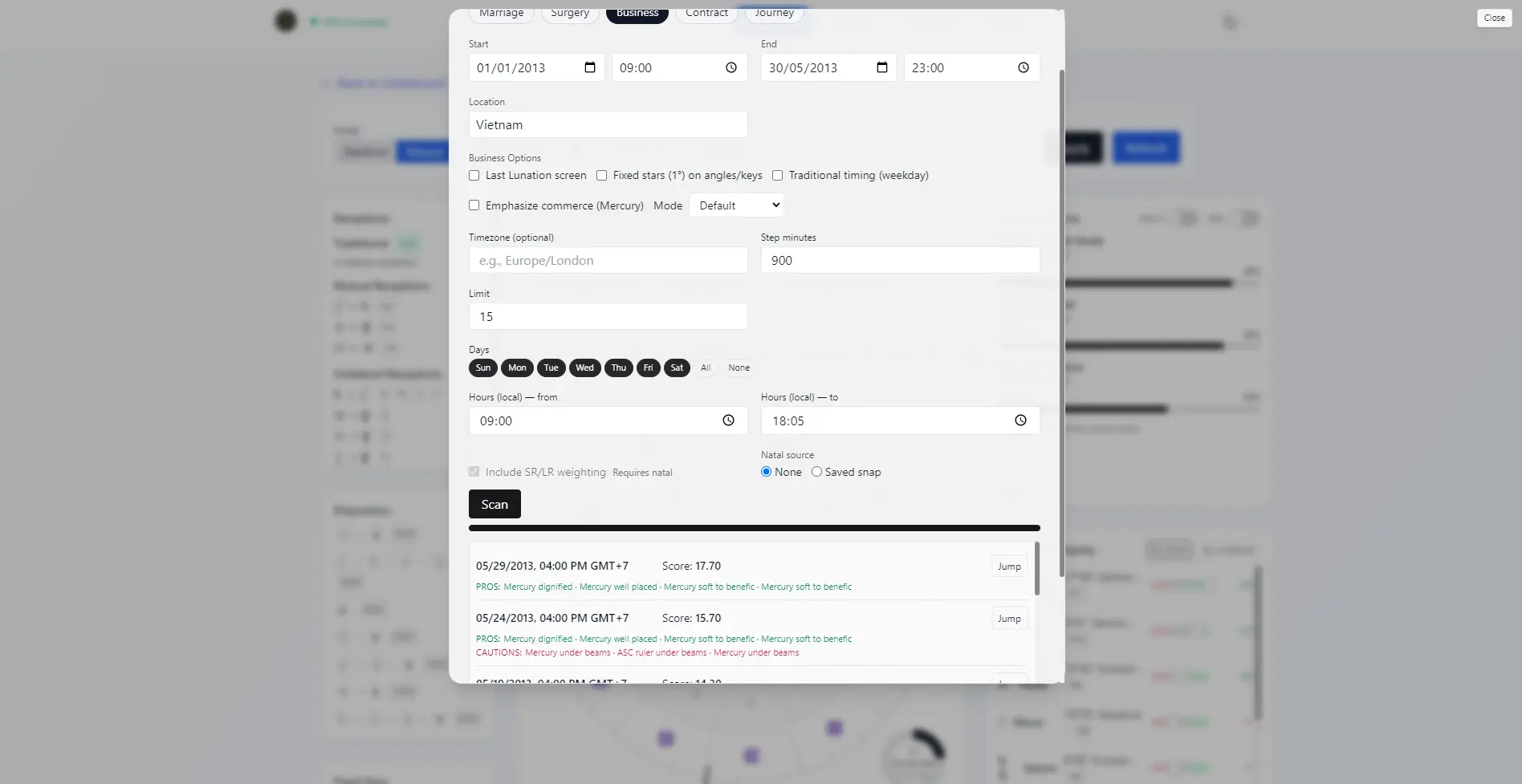
House rotation is everything. Changing from 9:30 AM to 4:00 PM at the same location spins the ASC/MC so different planets become angular (louder) or cadent (quieter). In the 4:00 PM window highlighted by our scanner (above), Mars is strongly 10th-house angular and the Mercury - Venus cluster sits in the 11th - a configuration that supercharges visibility and social spread.
If you pivot to 9:30 AM, those same bodies likely slide into different houses, softening angular Mars and changing which houses Mercury/Venus activate (for example, more 10th or 12th emphasis depending on the day's diurnal motion). Key point:
- Viral lift depends on angularity + 11th-house wiring - an afternoon election can outperform a morning one for reach.
- Longevity, however, is mainly a 4th-house story. Unless a different time moves the Moon/Saturn out of the 4th or improves reception/dignity, Morin would expect a similar endgame - perhaps the boom/bust curve is less extreme, but the structural limit remains.
So, yes - 4:00 PM could have produced a hotter launch than 9:30 AM. But without re-engineering the 4th-house problem, the ending probably rhymes.
Pro Marketing Feature: Our Election Scanner for Business
The scan shown above covers 1 January to 30 May 2013 for Vietnam in business mode, with local hours limited to the working day. Its top result was 29 May 2013 at 4:00 PM (GMT+7, score 17.70). Launch day, 24 May 2013 at 4:00 PM (GMT+7), ranked second (score 15.70): Mercury was dignified and well placed, but the scanner also flagged Mercury and the Ascendant ruler as under the Sun's beams.
What our app does for you:
- Scans a date range with your location/timezone.
- Filters by days/hours you actually launch (no 3 a.m. deploys unless you want them).
- Scores windows using Morin-style dignity, reception, angularity, Moon condition, and SR/LR weighting when desired.
- Explains why a window ranks (e.g., "Mercury dignified; 11th-house emphasis; Mars angular in 10th").
Reading the launch-day result: the 24/05/2013 16:00 slot likely earned its high score because it emphasized Mercury, Venus, and Jupiter in the 11th while keeping Mars angular, a recipe for short, sharp virality. The under-the-beams cautions are the kind of weakness the scanner surfaces so you can weigh it before choosing.
Why That Day Ranked Highly
The 4:00 PM window featured Mercury/Venus conjunction in the 11th house (social virality), strong angularity for Mars (public visibility), and favorable hour blocks that aligned planetary rulers with benefic aspects. Our scanner prioritizes these configurations for business launches seeking rapid adoption.
Implementation Playbook
How founders & marketers can use elections responsibly:
- Pick the event moment carefully: App-store "Release" click, payment switch-on, or press embargo lift.
- Lock the city: Legal domicile or ops HQ.
- Choose a window: Run the scan for your week; shortlist top 3.
- Human review: Check Moon's applying aspects, angularity, and the 2nd/10th/11th rulers.
- Mitigate: If a malefic is angular, add reception or benefic aspects; avoid harsh 4th afflictions.
- Align ops: Ensure engineering, PR, ads, and support are staffed in the first lunar cycle post-launch.
FAQs
What exactly "starts" the chart for a business launch?
The earliest public moment that creates consequences - publishing the app, flipping payments live, sending the press release, or opening the doors.
Is election astrology only for launches?
No. It also helps with signing contracts, incorporations, funding announcements, partnerships, and store openings.
Do I need my (or my company's) natal chart?
It helps. You can align elections with founders' charts or a company natal; but for pure event launches, an event chart alone can work.
How much can timing really change?
Often, quite a lot in the first-week outcomes (visibility, ranking, conversion). Structural long-term issues (e.g., a badly hit 4th house) need different elections, not just hour shifts.
Should I avoid Mercury retrograde for every tech launch?
Not automatically. If Mercury is well-dignified, angular, and supported by reception, Mercury retrograde can be navigated. Focus on the whole chart.
Did famous people truly use election astrology?
Yes - Elizabeth I had John Dee pick her coronation date; the Reagans scheduled with Joan Quigley; financier J.P. Morgan is documented as a client of Evangeline Adams (though the viral quote about billionaires is poorly sourced).
Can your app tell me if 4:00 PM beats 9:30 AM?
Yes. It ranks both, shows the why, and lets you compare angles, receptions, and Moon condition side-by-side.
Conclusion & Next Steps
Election astrology gives entrepreneurs a repeatable timing framework: strengthen Mercury/Venus/Jupiter, empower the angles, and stabilize the 4th house so your wins last. The Flappy Bird case shows how an 11th-house rocket can outpace its 4th-house foundation - a brilliant launch that couldn't be comfortably sustained.
Try the Election Scanner to shortlist your top launch windows. In the scan above, 24/05/2013 16:00 ranked second, the kind of slot that pushes viral adoption. When you're deciding between 4:00 PM and 9:30 AM, check what the shift does to the angles and the Moon. If you want a different ending, choose a window that repairs the base, not just one that boosts the megaphone.
Sources & Useful Reading
- Reagan/Quigley scheduling overview (PBS)
- Elizabeth I's coronation date via John Dee (Wikipedia)
- Muhurta (Encyclopedia Britannica)
- Flappy Bird timeline & removal (Wikipedia)
- Electional astrology overview (Wikipedia)