
Netflix's The Crash revisits the Strongsville, Ohio vehicle-death case involving Mackenzie F. Shirilla, Dominic "Dom" Russo, and Davion Flanagan. What first appeared publicly as a tragic crash became a murder case, and the public record now gives a useful benchmark for forensic astrology: a dated event, a documented vehicle impact, two fatal outcomes, one surviving driver, a known relationship structure, and a later conviction.
The Cuyahoga County Prosecutor's Office reported that the crash happened at approximately 5:30 a.m. on July 31, 2022, when Shirilla drove a Toyota Camry into the PLIDCO building near Progress Drive and Alameda Drive. The office said the vehicle accelerated to about 100 mph before impact and that data showed no brake application. Russo and Flanagan died. Shirilla survived and was later convicted after a bench trial; the Ohio Court of Appeals affirmed the convictions in State v. Shirilla, 2024-Ohio-4674.
For Vox Stella, the question is narrow and practical: when the forensic astrology workspace receives the sourced event date, time, and place, does the engine surface the same broad pattern that later became clear in the case record?
The Input Used for the Benchmark
The chart was cast for the crash event itself:
- Date: July 31, 2022
- Time: 5:30 a.m.
- Location: Strongsville, Ohio
- Timezone: America/New_York
- Case type: General
- House system: Regiomontanus
The general case type matters because the deceased victims were adult males, while the convicted driver was a young woman. Choosing an adult-female victim profile would have told the engine to prioritize the wrong case structure.
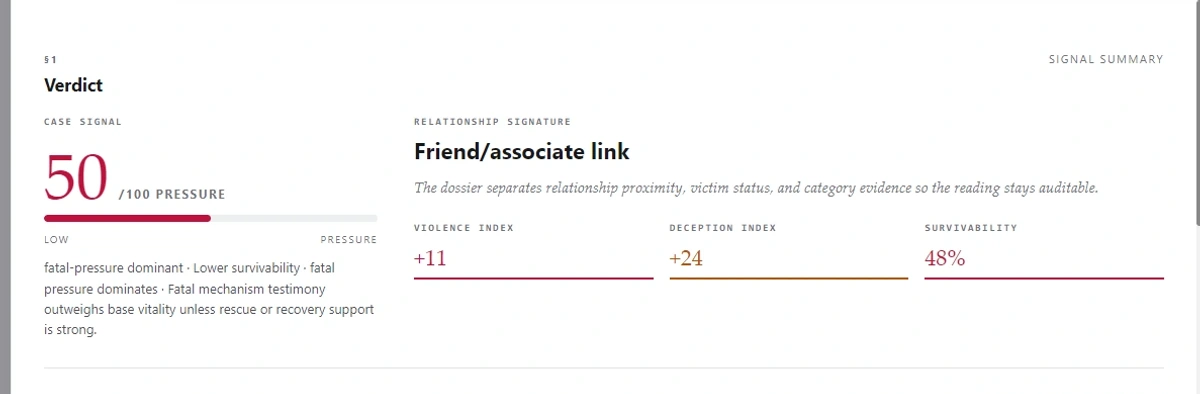
Friend/associate link.Step 1: The Engine Saw Fatal Pressure Before It Saw a Story
The dossier scored the case at 50 / 100 pressure, with survivability at 48%, and labeled survivability direction as Lower. The short explanation was direct: fatal pressure dominated the chart.
That matches the real event family. Russo and Flanagan died from the crash, while Shirilla survived. The important product point is that the engine did not soften the reading just because one person lived through the impact. It weighted the fatal mechanism above baseline vitality.
The fatal read came from the combined rule stack: vehicle crash and transport harm patterning, survivability calculation, Mars and Saturn pressure, Mercury-Saturn and Mercury-Mars transport testimony, and route/impact symbolism.
Step 2: The Findings List Put Vehicle Harm First
The findings list shows what the engine prioritized before any editorial interpretation was added.
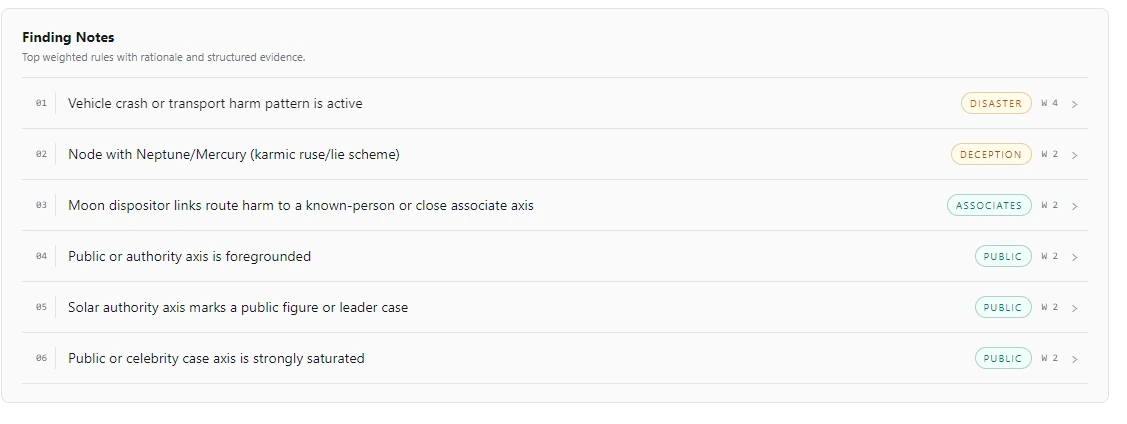
The first finding was Vehicle crash or transport harm pattern is active. That is exactly the real-world event family: road route, high-speed vehicle, building collision, fatal blunt-force impact, and disputed intent.
The second finding, Node with Neptune/Mercury, points to narrative fog, confusion, ruse, or disputed explanation in the software's language. In the public case, the legal battle centered on accident versus intent, including speed, steering, braking, prior conduct, and relationship conflict.
The third finding is the calibration point: Moon dispositor links route harm to a known-person or close associate axis. Russo was Shirilla's boyfriend, and Flanagan was a friend and passenger. The engine did not name those roles with courtroom specificity; it moved the case away from random crash symbolism and toward known-person involvement.
Step 3: Why the Vehicle Crash Rule Matched the Case
Opening the top finding shows the exact rule logic behind the crash read.
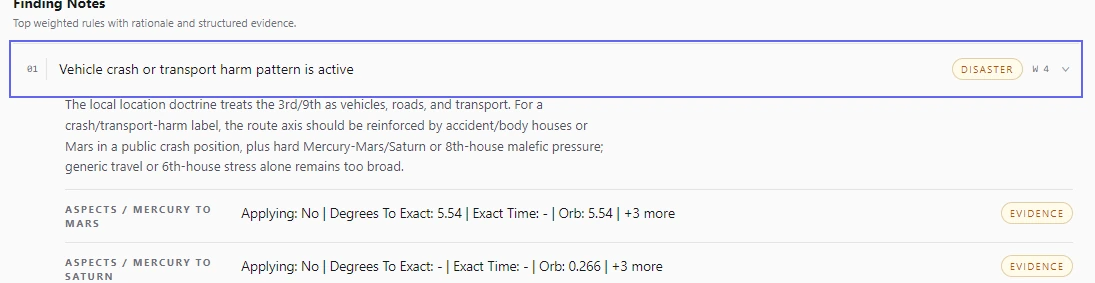
Vox Stella treats the 3rd and 9th houses as the local doctrine for vehicles, roads, and transport. The vehicle-crash rule becomes stronger when the route axis is reinforced by accident/body houses, Mars in a visible crash position, hard Mercury-Mars or Mercury-Saturn pressure, or 8th-house malefic pressure.
In this chart, the evidence included Mercury to Mars hard pressure, Mercury opposite Saturn with a tight orb, Mars in a public or visible crash position, and Saturn tied to death or manner-of-death symbolism.
Against the documented case, this was the strongest match. The event was a car crash into a building; prosecutors said the vehicle accelerated before impact; the vehicle data recorder became central to the case; and the difference between accident and intentional crash became the legal battleground.
Step 4: The Victim Layer Saw Fatality, Not Survival Optimism
The victim analysis is where the survivability logic becomes visible.
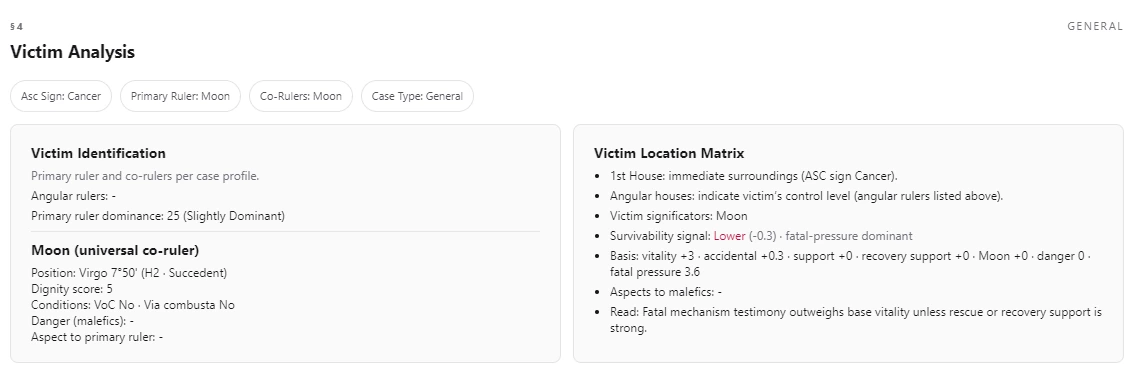
The chart used Cancer rising, making the Moon the primary ruler. The Moon was in Virgo in the 2nd house, with enough dignity to show baseline vitality. A simpler engine might have leaned too heavily on that condition and produced a softer survival read.
Instead, the dossier stated: Fatal mechanism testimony outweighs base vitality unless rescue or recovery support is strong. That is the correct direction for the event as documented. Two passengers died, and the crash mechanism was severe enough that vitality symbolism could not carry the reading into a survival-dominant result.
Step 5: Moon Dispositor Logic Found a Known-Person Bridge
The relationship layer is the most useful fine-grain test in this case. The records and reporting identify Russo as Shirilla's boyfriend and Flanagan as a friend/passenger. The engine's relationship signature was Friend/associate link.
That is the right confidence level for the chart output. It says the case was not random; it does not pretend to know every legal and emotional detail of the relationship from the chart alone.
The technical key is Moon in Virgo. Virgo is disposed by Mercury. In this chart, Mercury is tightly opposed to Saturn, the 7th ruler. Saturn sits in an 8th-house death context. Because the same chart already had strong vehicle and route testimony, that Mercury-Saturn bridge became meaningful:
- Moon: victim layer and event movement
- Virgo: Moon handled through Mercury
- Mercury: route, vehicle, communication, and narrative
- Saturn: 7th ruler or other-person axis, placed in death context
- Mercury opposite Saturn: a hard bridge between route testimony and the other-person/death axis
That is why the updated engine reads this as a known-person or close-associate link rather than a stranger/random pattern.
Step 6: Saturn and Mars Shaped the Perpetrator-Axis Profile
The perpetrator panel adds the final product layer: the 7th-house and hard-malefic profile.
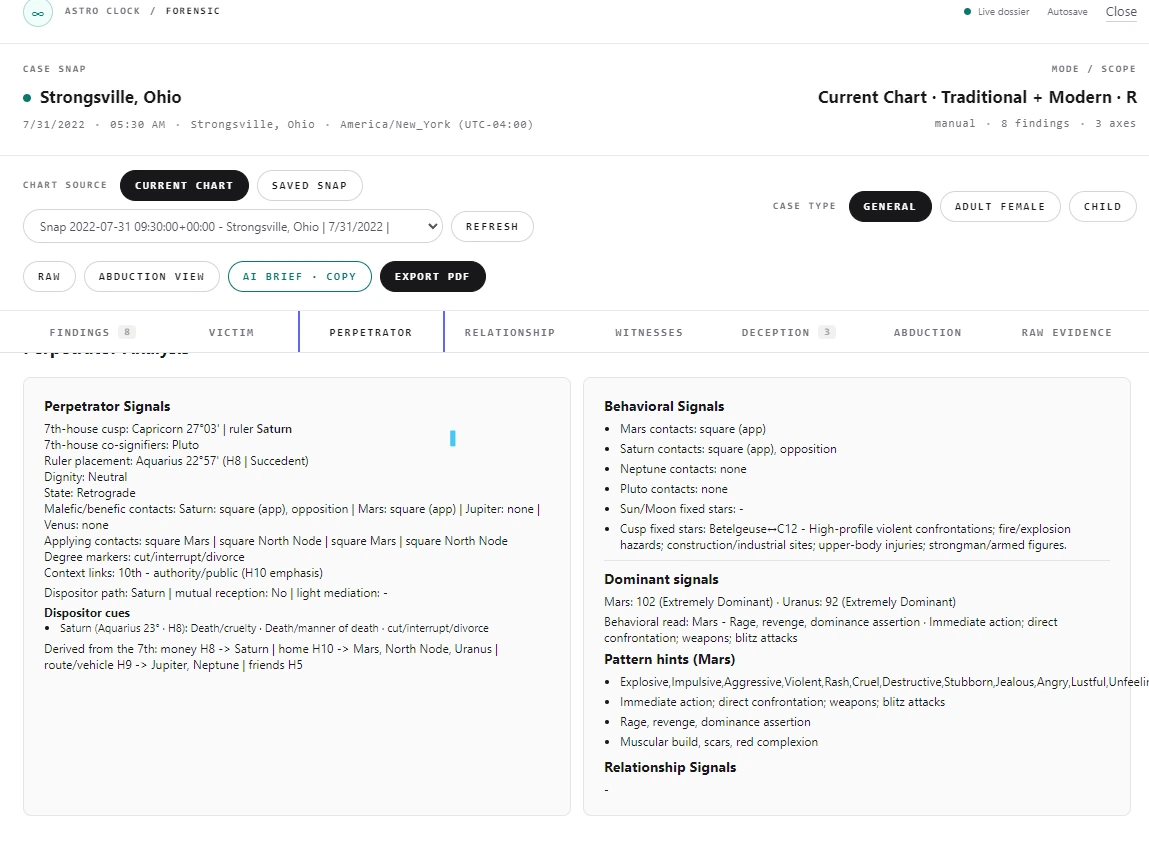
In the software's forensic model, the 7th-house cusp in Capricorn made Saturn the 7th-house ruler and the other-person/perpetrator-axis ruler. Saturn was in Aquarius in the 8th house and retrograde. Mars was extremely dominant. Uranus was also extremely dominant. The panel also tied the context back to public, route, and vehicle themes.
The Mars range matters because the documented event was not a symbolic danger marker; it was a high-force impact. Mars dominance fits speed, collision, force, and physical violence. Uranus adds sudden rupture, shock, and mechanical or vehicular disruption. Saturn in the 8th adds death, finality, consequence, and legal seriousness.
The behavioral range in the output included rage, revenge, dominance assertion, immediate action, direct confrontation, and destructive, jealous, angry, and uncompromising tones. The court record supplies the factual relationship context: Russo's mother testified that the relationship had become strained and described arguments, breakups, threats, and possessiveness. That is where the product output and the legal record meet most clearly. The chart gives a pressure range; the record supplies the specific testimony.
Engine Output vs. Real Events
| Question | Vox Stella output | Case comparison |
|---|---|---|
| Was this a vehicle or route event? | Vehicle crash or transport harm pattern is active |
Strong match. The case centered on a high-speed car crash into a building. |
| Was the event fatal? | Lower survivability, fatal pressure dominant |
Strong match. Russo and Flanagan died; Shirilla survived. |
| Was it random? | Friend/associate link |
Strong directional match. Russo was Shirilla's boyfriend; Flanagan was a friend/passenger. |
| Was narrative conflict present? | Mercury/Neptune style findings and deception index pressure | Partial match. Public and legal conflict centered on accident versus intent. |
| Did the engine overclaim the relationship? | No. It stayed at known-person/friend-associate level. | Appropriate. The exact boyfriend/friend distinction comes from records. |
What This Case Shows About Vox Stella
The Shirilla case is useful because it forces the forensic tools to handle overlap. It was a crash, but not merely a crash. It was a fatal vehicle event that became a murder case. It involved a romantic relationship, a friend passenger, disputed narrative, public legal visibility, and survivor-versus-victim separation.
The strongest layers were clear:
- The engine identified the crash and transport axis.
- It kept fatal pressure above survival optimism.
- It found the known-person bridge through Moon-dispositor logic.
- It used Saturn as the perpetrator-axis ruler without turning that into unsupported biography.
- It treated Mars dominance as a force, speed, impact, and domination signal rather than generic danger language.
That is the product value of Vox Stella: the chart output becomes a structured forensic dossier that can be compared, point by point, with the documented record.
Final Takeaway
Netflix's The Crash is compelling because the story turns on interpretation: accident or intent, chaos or control, teenage tragedy or calculated crime. Vox Stella's forensic engine approached the same event from symbolic structure: route and vehicle testimony, Mercury-Mars and Mercury-Saturn pressure, fatal survivability override, Moon-in-Virgo handled through Mercury, and Mercury hard-linked to the 7th ruler in a death context.
The result is one of the cleaner vehicle-crash tests in the forensic astrology engine. The dossier did not simply say "car accident." It saw a fatal transport event with known-person involvement, heavy Mars/Saturn pressure, and public/legal force - close to the documented shape of the Mackenzie Shirilla Strongsville crash case.
FAQ
What is Netflix's The Crash true story about?
The Crash covers the Mackenzie Shirilla Strongsville crash case. On July 31, 2022, Dominic Russo and Davion Flanagan died after a Toyota Camry driven by Shirilla struck the PLIDCO building in Strongsville, Ohio. Shirilla survived and was later convicted.
Why did Vox Stella use July 31, 2022 at 5:30 a.m.?
That is the approximate crash time reported by the Cuyahoga County Prosecutor's Office. The event chart was cast for the crash itself, not for birth data, later sentencing, or documentary release timing.
What was the strongest Vox Stella match in the Mackenzie Shirilla case?
The strongest match was the vehicle crash or transport harm finding, supported by route houses, Mercury-Mars pressure, Mercury-Saturn pressure, Mars visibility, and 8th-house malefic pressure.
How did the engine handle Dominic Russo and Davion Flanagan?
The engine did not name individuals. It read a known-person or friend/associate relationship signature. The records identify Russo as Shirilla's boyfriend and Flanagan as a friend/passenger.
Why is Saturn important in this chart?
Saturn ruled the 7th house in the dossier's perpetrator-axis model and sat in the 8th house. That tied the other-person axis into death, consequence, finality, and legal seriousness.
Where does Mars dominance show up in the real case comparison?
Mars dominance fits the high-force physicality of the event: speed, collision, impact, and destructive assertion. The jealousy or possessiveness range is treated as a signal range, while the court record supplies the specific relationship testimony.
Sources and case references
- Cuyahoga County Prosecutor's Office: Strongsville woman sentenced to life in prison for crash that killed two
- Justia: State v. Shirilla, 2024-Ohio-4674
- AP News: Ohio teen sentenced in fatal crash case
- Netflix Tudum: The Crash release date and case overview

VoxStella - Forensics
Forensic event charts, bundled public case snapshots, and structured symbolic evidence review on iPhone and iPad.